
Seeing harmful content about you or your business on page one of Google can feel overwhelming. It can impact trust, sales, partnerships, hiring, and even personal safety.
The good news is you have options, and the faster you act, the better the outcome.
This guide walks you through what to do first, what to avoid, and when it makes sense to bring in professional support.
1) Stay Calm And Capture Evidence (Before Anything Changes)
Harmful content can move, be edited, or be taken down without warning. Before you report it, dispute it, or contact anyone, collect a clear record. Take screenshots of the search results page (including the query you used), the harmful page itself, and any author name, website name, and publishing date. Copy and save the URLs for both the search result and the page, and note the keywords that trigger it (brand name, director name, product name, etc.).
This helps you prove what happened, build a removal strategy, and measure progress.
2) Work Out What Type Of Content It Is
Not all page-one results can be handled the same way. The route to removal, suppression, or correction depends on where it is hosted and why it ranks.
Common examples include news articles, blog posts, review sites, forum posts, social media posts, data broker listings, court or regulatory records, scraped or republished content, and fake profiles (including impersonation or doxxing).
If you can identify the category, you can usually narrow down the quickest path.
3) Decide Whether Removal Is Realistically Possible
There are three broad outcomes in reputation management:
- Direct removal (best outcome)
- De-indexing (removed from search results, but may remain online)
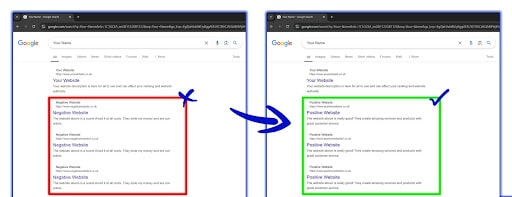
- Content burial/suppression (replacing negative results with stronger positive content)
Direct removal may be possible when the content violates platform policy (harassment, hate, threats, impersonation), includes personal data (doxxing), is demonstrably false and defamatory, is hosted on sites willing to correct or remove it, or there are legal grounds such as a valid privacy or data protection claim.
If direct removal is not an option, a structured content burial strategy can still deliver strong results by pushing the negative page down.
4) Avoid These Common Mistakes
In the first 24 to 72 hours, many people unintentionally make the situation worse. Do not contact the publisher angrily (it can trigger more coverage or screenshots), and do not post a public argument (responding can increase visibility and backlinks). Avoid asking friends to “click it to check,” because extra clicks can signal relevance.
5) If It Is A Review: Respond Carefully And Strategically
For review sites, speed matters, but so does tone. Keep your reply short, factual, and calm, invite the reviewer to resolve it privately, and avoid admitting fault if you are unsure. If the review is fake, report it with evidence.
A well-written response can reduce conversions lost to the review, even before removal or suppression work begins.
6) If It Is A News Article Or Blog Post: Explore Correction, Removal, Or Legal Routes
For editorial content, you generally have four routes: a correction or update (best when there are factual errors), a right of reply (to add your perspective), removal (rare, but sometimes possible), or de-indexing (in certain circumstances).
If the content is false, defamatory, or includes private information, you may have stronger options. In serious cases, get qualified legal advice alongside a PR plan.
7) Report Policy Violations And Safety Risks Immediately
If the content includes threats, hate, stalking, impersonation, non-consensual imagery, or personal addresses or phone numbers,
Use the platform’s reporting tools straight away and consider escalating to appropriate authorities if there is any risk of harm.
8) Build A Positive Content Plan (So Page One Is On Your Terms)
When removal is uncertain or slow, content burial can protect you quickly.
A strong plan usually includes a fast website refresh (clear service pages, strong location targeting, technical SEO), new authoritative content (helpful articles that match what people search), brand assets (company pages, profiles, leadership bios), press and PR placements where appropriate, video and rich media that can rank in its own right, and consistent posting to build trust signals over time.
The goal is simple: replace the negative with better, stronger, more relevant results.
9) Track Performance Weekly, Not Daily
Search results can fluctuate. Set a routine that is measurable and sustainable: track your top keywords, record what appears on page one, measure movement (position changes) and visibility, and update the plan based on what is actually ranking.
If you need faster movement, that is usually a sign you need a stronger mix of removal work and higher-authority content.
10) When To Bring In Professional Support
It is time to get help when the content is causing lost revenue or reputational risk. Right now, you are dealing with multiple harmful results, the site is refusing to engage, the content is spreading across platforms, or you need a discreet approach.
At White Lily Reputation, we specialise in content removal, content burial, and fully managed online PR.
If harmful content is appearing on page one, book a free consultation, and we will map out the quickest route forward.